


The doctrine of separation of powers is central to Australia’s constitutional system. Parliament makes laws, the executive administers them, and the judiciary interprets and applies them.
This is true of all democratic systems: judges are expected to interpret the law rather than create it. They are deliberately unelected and independent so that they can decide disputes impartially.
Their legitimacy comes from applying statutes passed by elected parliaments within principles established by constitutions. When judges move beyond interpretation and begin effectively making policy, they risk undermining democracy and weakening public confidence in the courts.
Law-making belongs to parliament where elected representatives can be voted out if the public disagrees with them.
Supporters of judicial activism argue that judges must adapt the law to changing social values. However, judicial creativity undermines certainty. Both citizens and governments need to know that laws will be interpreted according to established principles rather than the personal philosophies of individual judges.
In 2026, the New South Wales Court of Appeal struck down anti-protest laws introduced after the Bondi Beach terror attack, the court holding that the legislation “impermissibly burdened” the implied constitutional freedom of political communication.
While the ruling was praised by civil liberties groups, the reality is that judges were intruding into inherently political matters involving public safety and protest regulation.
Law-making belongs to parliament where elected representatives can be voted out if the public disagrees with them.
During protests surrounding the 2026 visit of Israeli President Isaac Herzog to Sydney, NSW courts initially upheld expanded police powers restricting demonstrations, accepting the government’s argument that the measures were necessary for public safety. Later, however, broader anti-protest measures were declared unconstitutional. The judges were profoundly influencing political and social disputes.
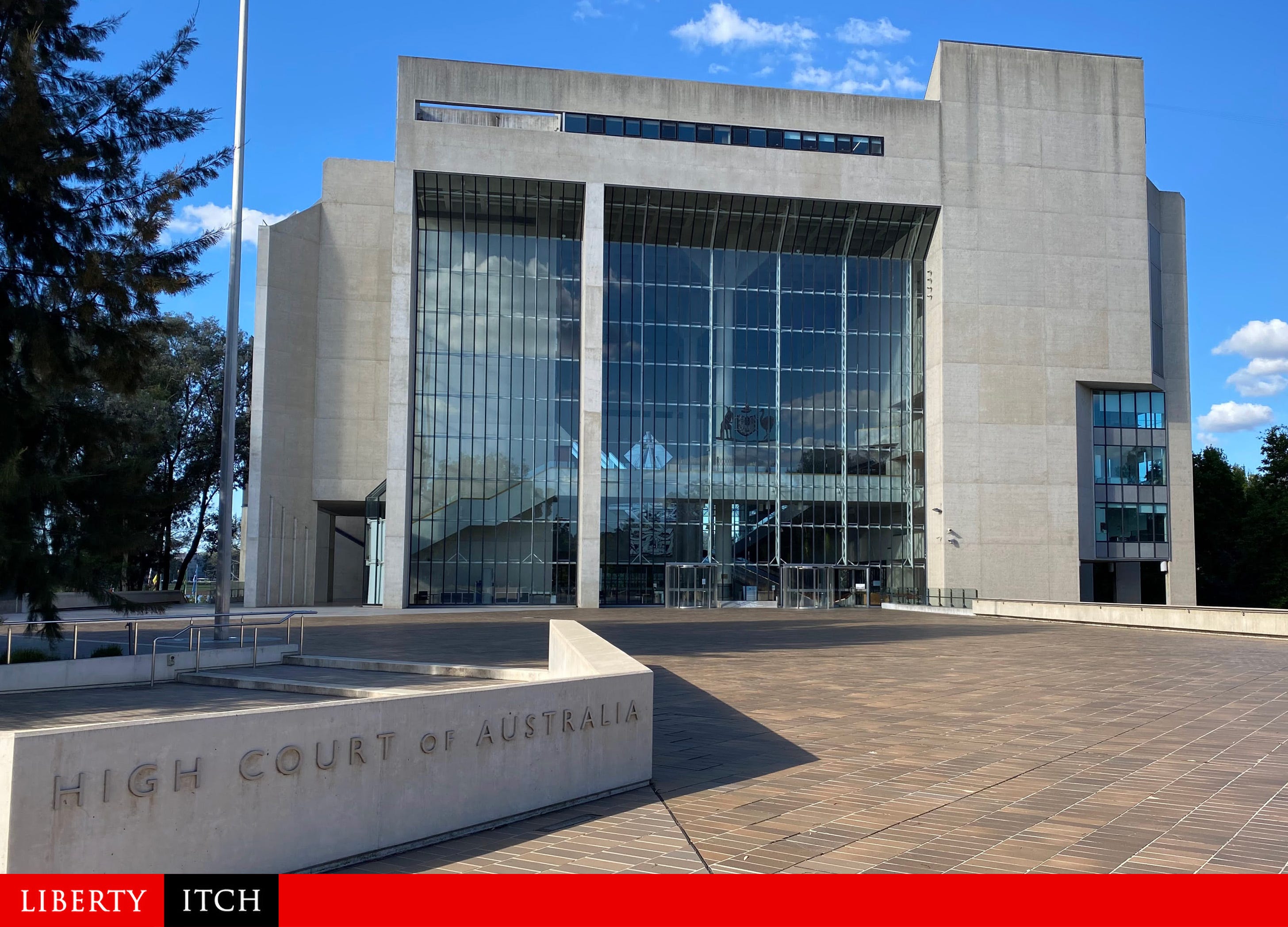
The problem is, not a single word in the Australian Constitution provides for freedom of political communication. It is entirely, from beginning to end, an invention by the judges of the High Court.
Another example, by the High Court, is its decision in Love v Commonwealth (2020), where it ruled that Aboriginals who are not citizens cannot be considered “aliens” under the Constitution.
The Constitution contains no explicit exception of this kind; the court effectively created a new constitutional category.
There are other cases: for example, the High Court has decided that prisoners serving sentences of three years or less cannot be prevented from voting, while those serving longer sentences can be, despite the Constitution saying no such thing. In another case the High Court decided it, not Parliament, had the power to supervise when electoral rolls must close.
Inevitably the lower courts see the example of the High Court and follow suit, deciding cases according to their individual biases. In the Tickle v Giggle case, for example, it was open to the court to interpret the definition of “gender identity” in the Sex Discrimination Act in a way that did not undermine the rights of women. It chose not to do so.
In the ACCC case against Coles, the court declared that 12 weeks must elapse between reasonable price increases and promotional cuts, if consumers were not to be misled. That ought to be a business decision, not the opinion of a judge. Merely setting out some key principles around honesty, transparency and accountability would have been far more appropriate.
Even in my defamation case, the court simply chose to disregard provisions of the Parliamentary Privileges Act which makes it unlawful for a court to interpret what was said in parliament, to conclude (with zero corroborating evidence) that something had not been said in parliament and therefore I could be found liable.
It seems to me that some judges believe they know better than politicians and simply base their decisions on what they think should be the outcome, rather than what the law provides. I suspect this reflects the same level of contempt for politicians found in the community; politics is messy and full of compromises, leading many people to conclude they could do a better job.
The problem is that this leads us to a similar situation to Israel. Israel’s High Court of Justice possesses unusually broad authority because the country lacks a single written constitution. The court has claimed the power, despite no legislative backing, to review government actions, strike down legislation, and intervene extensively in administrative decisions.
The Israeli court has become very powerful and unaccountable, effectively shaping national policy on issues ranging from security to settlements and religious matters. It even claims the power to appoint its own judges.
The controversy reached a peak in 2023 and 2024 during attempts by the Israeli government to implement reform, prompting mass demonstrations. Those opposed to the current government feared that reducing the court’s powers would weaken checks and balances, while government supporters argued that unelected judges had accumulated excessive influence over elected governments. It was a dangerously partisan period.
It seems to me that some judges believe they know better than politicians and simply base their decisions on what they think should be the outcome, rather than what the law provides.
The Israeli example demonstrates the dangers when courts move beyond interpretation into governance itself. With judges as central political actors, public trust in both democracy and the judiciary is eroded.
Democratic legitimacy depends on elected representatives making policy decisions, with clear boundaries between judging and governing. A strong democracy requires not only independent courts, but also judges who recognise their proper role.

Long time no chat. Your articles I thoroughly enjoy as they are factual, well written and easy to read. If ever in Bowral - call in for a cuppa. Give me a buzz: 0418246545
I am not a lawyer, but I have studied the law. During my studies, it became apparent to me that our modern judges are a pale shadow when compared to their predecessors. The role of a judge is to enforce the law as she is wrote and, where necessary, to provide clarity. A civil society requires certainty in the law. I will go as far as to say that in my uneducated and unprofessional opinion, after studying the law, the Mabo decision appears to be nothing more than a court contrivance and is in no way supported by the law or facts.