


For over a century, from 1900 to 2000, the average Australian family could buy its first home on a single income. Median house prices hovered at roughly three times median household income—an arrangement that reflected a relatively free market in land and housing.
Young people entered the market easily, built wealth, and enjoyed the liberty that comes with owning one’s home unencumbered by crushing debt.
Today that freedom is gone. In real terms, the median house price now exceeds ten times median income.
So what changed? Certainly not a sudden scarcity of dirt!
What changed is government.
In 2003, then-Treasurer Peter Costello asked the Productivity Commission to investigate the collapse of first-home ownership. The Commission responded by delivering one of the most destructive reports in Australian economic history.
Instead of identifying the real culprit—state-government planning monopolies that deliberately choke the supply of fringe land—the Commission blamed ‘demand’ driven by low interest rates and rising incomes, implying that supply was ‘inherently’ unresponsive.
This was an ideological sleight-of-hand dressed up as analysis.
Land on the urban fringes of Australia’s cities is effectively infinite.
The housing industry has proven, decade after decade, that it can deliver good quality homes at reasonable prices.
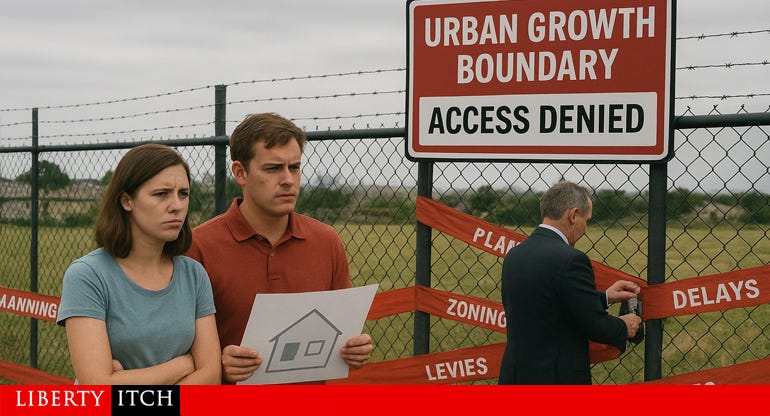
Yet state governments, captured by inner-city progressive voters and vested interests, impose urban growth boundaries, levy punitive infrastructure charges, and drag approvals through years of bureaucratic torture.
By refusing to name the state as the aggressor, the Commission shielded the most powerful vested interest in Australia
The result is deliberate scarcity—scarcity engineered by the state, not by nature.
The Productivity Commission refused to say this out loud.
Instead, it parroted the Reserve Bank line that the problem was too much demand meeting an ‘inelastic’ supply, thereby absolving the true planners of the disaster: state planning departments and local councils.
By shifting blame to monetary policy and ‘demographics’, the Commission gave state governments a free pass and left Canberra holding the bag.
The consequences have been catastrophic for liberty and prosperity.
Young Australians are now indentured for life.
Instead of building businesses, starting families early, or accumulating productive capital, they are forced to hand 40–60 per cent of their after-tax income to banks and existing landowners in the form of mortgage payments or rent.
This is not a market outcome; it is a government-enforced transfer of wealth from the young and productive to the old and propertied.
Every dollar diverted into inflated house prices is a dollar that cannot be invested in new plant, equipment, software, education, or travel.
Hundreds of billions—possibly trillions—have been misallocated into a government-created real-estate bubble instead of into genuine wealth-creating enterprises.
The capital structure of the entire economy has been distorted by state violence against property rights.
And violence it is. When a government uses zoning laws and planning schemes to prevent a farmer from subdividing his own land or stops a developer from building houses that willing buyers want to purchase, it is initiating force against peaceful, consensual exchange.
That is the textbook definition of aggression, and libertarians have always opposed it.
The Productivity Commission’s 2003 report was not merely wrong; it was an act of intellectual protectionism for the planning state.
By refusing to name the state as the aggressor, the Commission shielded the most powerful vested interest in Australia: the government planning bureaucracy and its inner-city cheer squad who enjoy capital gains at the expense of everyone else.
Yet state governments, captured by inner-city progressive voters and vested interests, impose urban growth boundaries
Real reform is simple and entirely compatible with libertarian principles:
Abolish urban growth boundaries and replace them with a presumption in favour of development. If an owner has serviced land and a willing buyer, the state has no legitimate business saying no. Residential development on the urban fringe needs to be made a “permitted use.” In other words, there should be no zoning restrictions in turning rural fringe land into residential land.
Allow the development of basic serviced allotments ie water, sewer, electricity, stormwater, bitumen road, street lighting and street signage. Additional services and amenities (lakes, entrance walls, childcare centres, bike trails, etc can be optional extras if the developer wishes to provide them and the buyers are willing to pay for them.
No upfront infrastructure charges and endless ‘contribution plans’. All services should be paid for through the rates system ie pay ‘as’ you use, not ‘before’ you use.
Privatize planning approvals. Any qualified Town Planner should be able to certify that a development application complies with a Local Government’s Development Plan.
End all subsidies and tax concessions that favour existing owners over new entrants—negative gearing, capital-gains tax discounts, first-home-owner grants that merely bid up prices. Let prices fall to their natural, market-clearing level.
Such reforms would see first-home ownership return to its traditional 20–25 per cent of the market, and young Australians would once again be free.
The Productivity Commission had the chance in 2003 to strike a blow for freedom and prosperity. Instead, it chose conformity, groupthink, and protection of the state’s egregious intervention in the economy.
Its failure is not the first, nor will it be the last, until Australians demand an institution that actually believes markets—especially land markets—should be free.

Correct, as always. I would add that the cost of infrastructure per person is higher the greater the population. Therefore, we ought to consider the lower costs and increase land availability available through decentralisation.
I would also add that capital gains tax causes a significant delay in the release of land (12 months ownership required to half the tax).
Absolutely correct sir 🤝🇦🇺