


The Murray Darling Basin Plan (MDBP) was established in 2012 in response to the Millennium Drought (1997–2010), which certain people believed was proof of climate change. In their view it would never rain heavily again, leaving the environment permanently short of water.
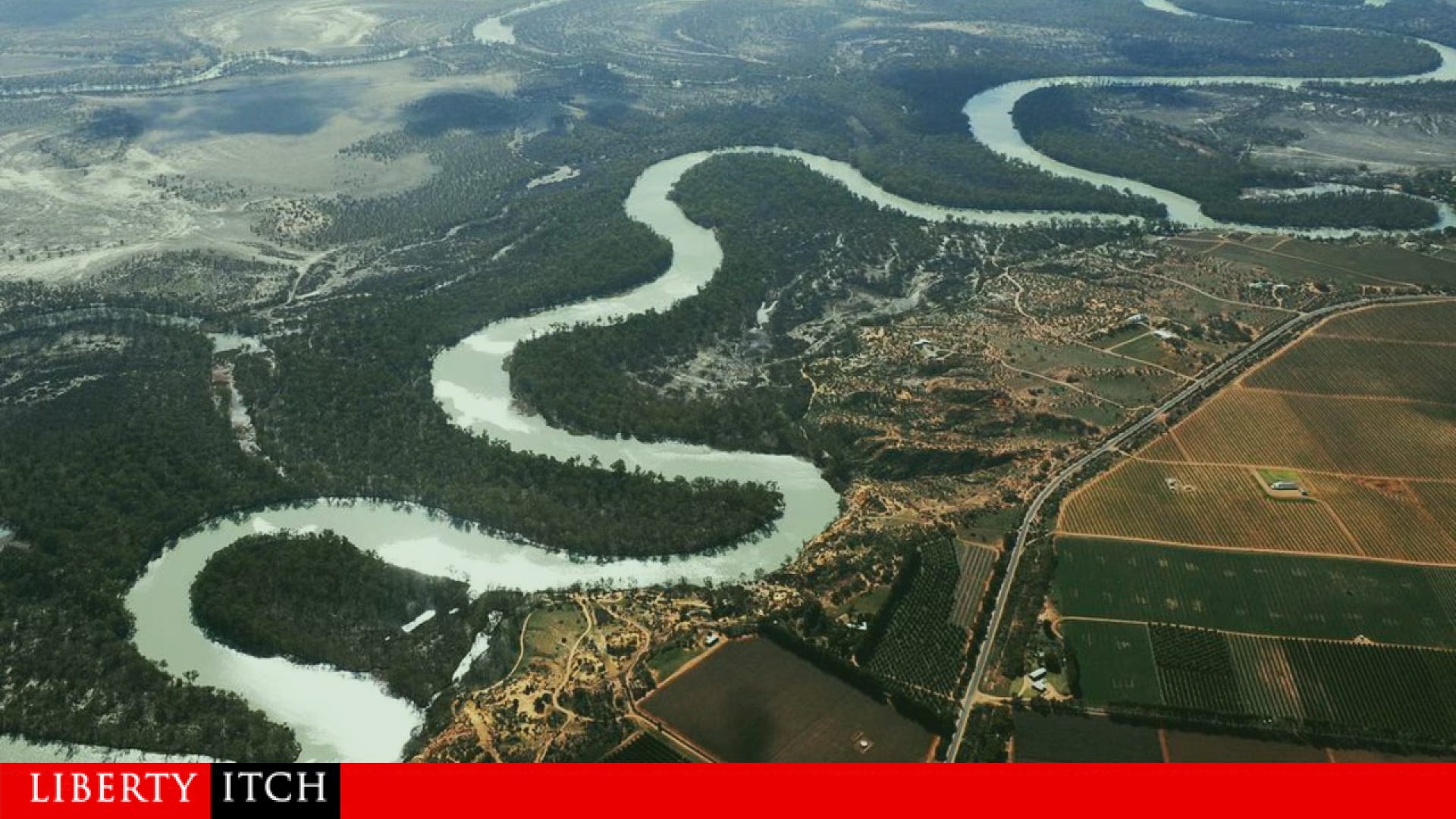
The issue gained particular currency in South Australia, where it was also claimed Adelaide’s water supply was at risk.
As wiser heads knew, and time has proved, the Millenium Drought was not unique and certainly not an indicator of the future. It was simply Australia being Australia, with its droughts and flooding rains.
Nonetheless, it resulted in a plan to send vast amounts of water down various rivers, most of it ending up in the Murray, supposedly to benefit the environment, keep the mouth of the Murray open, and to guarantee water for Adelaide.
The Plan called for the ‘return’ of 2,750 GL of water to the environment plus an additional 450 GL under certain conditions (now mostly achieved). This water came from farmers and rural communities in Queensland, NSW and Victoria, some through efficiency measures but mostly by buying water rights from farmers. That was water that would otherwise would have been used to irrigate crops.
Perhaps the environment is marginally better off in a few limited areas but, in terms of overall benefit, it is probably worse off.
These numbers were never science-based. They were back of the envelope calculations negotiated by politicians based on political considerations. There are a lot of votes to be won by saving the environment, even when it doesn’t need saving.
In South Australia there were six marginal seats for which both sides of politics were competing on the basis of offering the most water. The additional 450 GL was only added at the last minute in order to get the South Australians to agree to the Plan.
Under the Plan, of the 2,750 GL, SA is guaranteed a minimum of 1,850 GL a year. Delivering that much water means the Murray is now abnormally full all year round.
It was an absurd figure. According to the SA EPA, the state’s total water consumption is just 1,000 GL per year, of which agriculture consumes three-quarters. Households, manufacturing and mining account for the remainder.
Adelaide also has a $1.8bn desalination plant capable of producing half its household and industry requirements. The plant is obliged to use renewable energy though, which means it is expensive and rarely operates.
With so much water being sent across the border, a large proportion of it ends up in the so-called lower lakes, Lake Alexandrina and Lake Albert.
Until the 1930s these lakes were open to the sea, in common with every other river estuary in Australia. But then five barrages were erected which substantially changed the natural environment.
The barrages block sea water from entering the lakes, thus ensuring they only contain fresh water from the Murray. This prevents tidal flows from keeping the Murray mouth open, which is now quite silted and requires almost constant dredging.
Somewhere around 800-900 GL simply evaporates in the lower lakes. This is fresh water worth hundreds of millions of dollars in the water trading market, delivered from the eastern states via the Murray River, that evaporates into the atmosphere for zero environmental benefit.
Evaporation is unavoidable, but if the Murray mouth was open and the sea was free to enter the lakes, it could be seawater (or at least a mixture of fresh and seawater) that evaporated instead.
In this unreal world of environmental politics, it is assumed that sending more and more water down the Murray is somehow good for the environment and will keep the Murray mouth open. As is now apparent, this is completely wrong. Water only benefits the environment when it is present in the right place, in the right quantities, at the right time.
Delivering that much water means the Murray is now abnormally full all year round.
Put simply, the MDBP is perpetuating an artificial environment in SA at the expense of Australian farming and rural communities. The loss of water for irrigation in southern Queensland, NSW and Victoria has devastated many regional communities, while its wasteful loss in South Australia is unforgiveable.
Perhaps the environment is marginally better off in a few limited areas but, in terms of overall benefit, it is probably worse off.
What ought to happen is for the SA government to demolish the barrages and remove Bird Island, a sand island that has formed in the mouth of the Murray as a result of the effect of the barrages. This would allow the Murray to run free.
If a new weir was built across the Murray near Wellington to prevent seawater from moving too far up the river and contaminating either Adelaide’s supply in dry years, even a repeat of the Millenium Drought would be of no concern. Lakes Albert and Alexandrina would simply become intermittently saline and, with the Murray mouth open, the long-suffering Coorong would recover.
The MDBP was always a political solution to a political problem, but its consequences are not minor. We are long overdue for a dose of non-political reality.
