


On 16th June 2026 a Perth man Dayne Brajkovich handed his jacket to a homeless man outside a Perth court. Six hours later he was arrested.
Why was he arrested?
For wearing a belt that displayed ‘Mongols MC 1% East End’. A belt that no one present seemed to recognise, notice or care about other than WA police.
He was targeted under legislation introduced in 2021 that prohibits the public display (defined very broadly) of symbols associated with certain ‘identified organisations’, currently including a collection of bikie organisations but perhaps in the future might include other groups including political groups that the WA government doesn’t like.
The legislation bans the public display of the organisation’s name. the logo or patch of the organisation, any symbol, image or abbreviation that the government deems to be associated with the targeted group, along with the numeral value of 1% (and 1%er).
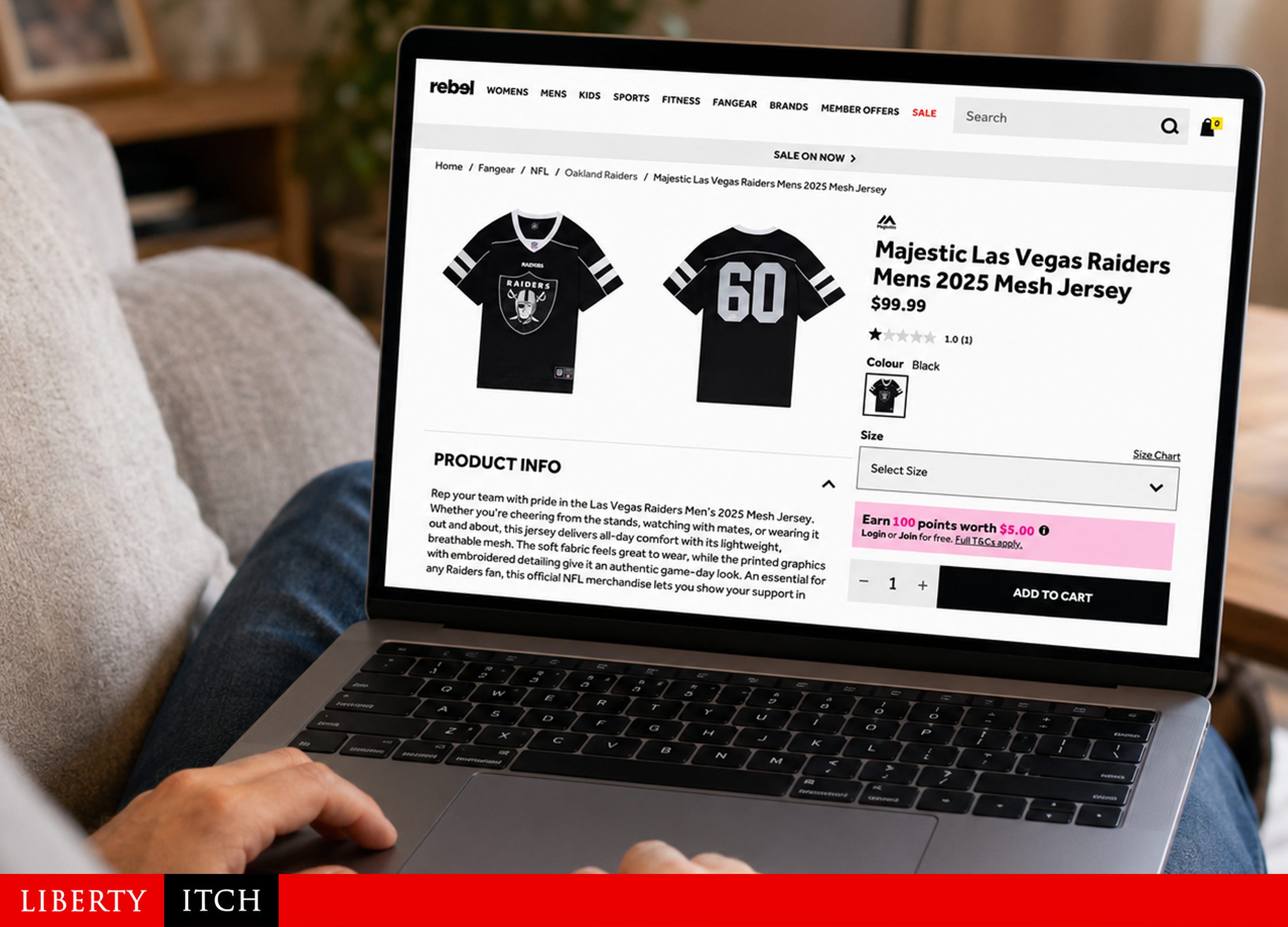
Along with another individual, Mr Brajkovich is also currently facing charges under the same legislation for wearing Las Vegas Raiders merchandise which, as of the 6th of July 2026, is available on the Rebel Sports website. How? Why? Because the WA police have decided that the emblem of an American sports team is now the symbol of a bikie group.
This is a good example of the Watermelon Effect. When you ban symbols, it does not eliminate the desire to express an idea or concept; people simply adopt new symbols to replace the banned symbols that also get banned. The cycle continues until you end up banning things that are impractical or stupid, such as the watermelon used by the Pro Palestinian Movement. I wonder what fruits the various bikie groups in Western Australia will eventually adopt?
Is Las Vegas Raiders merchandise now illegal in Western Australia? Are normal people now meant to keep up to date with current bikie fashion just to know what they can and cannot wear?
We live in a society where people wear tops with the names of bands they don’t listen to, sports teams they don’t follow, and companies and places they know nothing about. Will the WA government at least keep an updated webpage citing all currently illegal fashion?
Or is the law only applied to specific targeted people? People the police do not approve of? Will they mass collect data from surveillance cameras and use AI to identify the targeted people? Will they profile them based on their appearance, their dress, or whether they ride motorbikes?
In my view, legislation should focus on conduct, not status or identity. I don’t care if someone wants to ride a motorbike and identifies as part of a group. My concern is whether they violate the rights of others. The display of bikie insignia may be uncomfortable to some, but it does not inherently harm people or property, or violate the rights of others.
When you ban symbols, it does not eliminate the desire to express an idea or concept; people simply adopt new symbols to replace the banned symbols that also get banned.
In WA there is not even a requirement for anyone to be threatened or intimidated, or to report what someone is wearing. WA Police enforce the legislation by tracking where the targeted individuals go and trying to catch them on surveillance cameras.
For example, four people were arrested and three convicted for visible tattoos at a hotel pool party. The pool was still deemed a ‘public place’ despite being in what a reasonable person would consider a private area. The obvious question is whether recently passed anti-hate symbol laws will be enforced in a similar manner.
The criminalisation of existing tattoos is particularly disturbing given this seems to suggest that a person has a legal obligation to alter their own body against their will. Cover tattoos and laser tattoo removal are invasive and expensive processes. How can a person getting a tattoo in the present possibly know what tattoos will become illegal in the future?
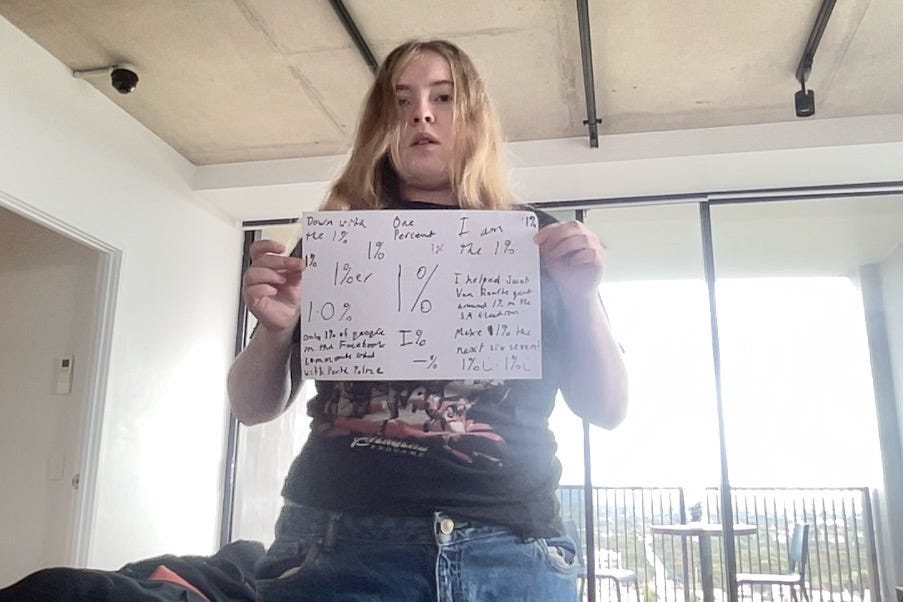
The criminalisation of the numerical value of 1% is particularly dumb and draconian given that it appears a lot, including in statistics and political slogans such as ‘down with the 1%’ and ‘we are the 1%’. Especially when the legislation makes no exception for political slogans.
Are some or all sections of the paper I am holding illegal in WA?
I initially discovered this story while scrolling through Facebook comments, which were highly critical of the arrest with many people describing the situation as stupid and a waste of taxpayer money and resources. The WA police may have thought they looked tough, but instead they came across as silly and authoritarian.

Raiders gear should be banned, because they suck. Jokes aside (Go Pats) this is proof positive the supply of government grossly outweighs its demand. They have to create problems to justify their existence in the name of "safety" - which is just petty tyranny at the end of the day.