


Over time, there has been an increasing crackdown on protest in Australia. This has led to people having fewer avenues to lawfully protest their grievances. Post and gloat laws will worsen the situation by limiting the ability of people to discuss and promote protests and political causes in cases where the government does not approve of a political movement. People who film and share footage of protests that has been condemned by the government or deemed to involve illegal activity will be criminalised and can lead to mass arrests.
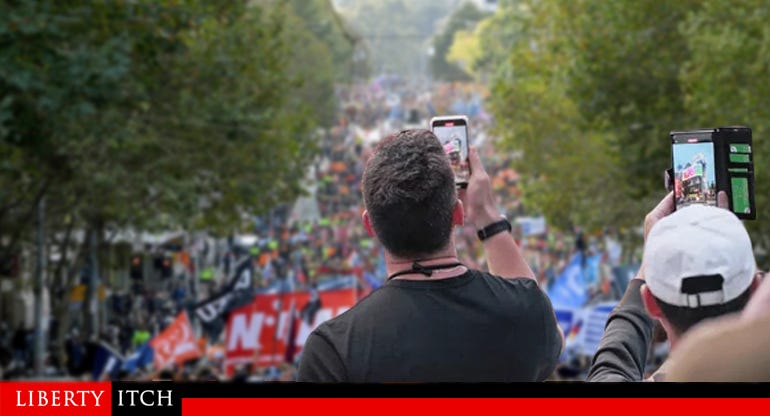
As a result, protesters will feel reluctant to film footage of the protest for fear of arrest. This makes it more difficult to document repressive and illegal government behaviour and represents a form censorship. Another disturbing quirk to this legislation has the potential to criminalise footage of things that were illegal in the past but are not now.
As a result, people who share footage such as the Melbourne anti lockdown protests and are in support of the protests which at the time were illegal could be charged with posting and boasting. Indeed, any footage of a protest that involves civil disobedience will be illegal to share by supporters. For example, the flash mobs that occurred near the beginning of the Melbourne lockdowns or someone smoking marijuana at a pot legalisation rally.
People who post footage of people engaging in criminal acts with nuanced commentary could also be criminalised
The legislation could also be applied to people who share footage of political speeches where the government has deemed parts of the speech to be hateful, offensive or violates some other speech code. As I mentioned in my first article, the government must merely show that the content of the speech might be illegal or ‘glorifies’ speech that violates speech codes.
There is also the matter of footage of arrests and police brutality. It is not uncommon for victims of police brutality to also be engaging in acts that are against the law or accused of engaging in acts that are against the law. This will affect people who choose to film and publicly share footage of encounters with police either involving themselves or other people.
Those who choose to livestream (especially at protests) will carry increased risks because people don’t know what will happen in the future and acts that might break the law caught live, potentially putting the person in violation of the law. The lack of specificity as to what illegal acts the law applies to further complicates the matter.
People who post footage of people engaging in criminal acts with nuanced commentary could also be criminalised if the government decides the commentary or footage is too sympathetic towards the person breaking the law. Those who post content of crimes with funny or amusing characteristics including memes could find themselves on the wrong side of the law.
The legislation could also be applied to people who share footage of political speeches where the government has deemed parts of the speech to be hateful
It isn’t unusual for footage of such crimes to go viral on the internet which could lead to the mass arrest of people who are otherwise law abiding. Something as simple as sending someone a photo of a piece of graffiti you found funny or the clown pie assault example at the beginning of my first article in this series could put you on in legal jeopardy. I find this highly unfortunate since poking fun at elements of crimes is part of our culture.
It is not uncommon for people to be curious about things happening in the community. Being able to film things that occur in the community is important and whether the person filming that footage has noble intentions or not does not undermine the value of that footage or make it any less in the public interest.
If people fear that they could be arrested for appearing too sympathetic towards any acts that are deemed illegal, they may choose to not share it at all and self-censor. This can be a problem if you or someone you care about is accused of a crime. I will delve deeper into this in my last part of the series.
