


Every now and then an act of government incompetence and waste is so egregious that it’s enough to wake the beast within.

“We spent $6,000 per household over seventeen years and all we got was this lousy connection and the inspiration for 5 seasons of Utopia”
On 7 April 2009, Kevin Rudd announced the largest infrastructure project in Australian history. The occasion for the announcement was the collapse of the previous approach: a competitive tender process had just been terminated on the basis that no proposal offered value for money.
The government decided within hours that it knew best and proposed its own government-owned monopoly solution with no cost-benefit analysis or business case made . The project promised a fibre optic network to 93% of Australian premises at a cost of $43 billion to be finished in eight years.
“Just as railway tracks laid the foundation for the 19th century,” Rudd told the press, “broadband is the core infrastructure of the new century.”
Great line, but it hasn’t aged well.
South Koreans are watching 8K video on connections faster than most Australian businesses can access.
By 2013, when the Coalition took office, the FTTP rollout was already behind schedule and over budget. Malcolm Turnbull, as Communications Minister, announced the Multi-Technology Mix: a cheaper, faster alternative using existing copper and HFC networks. The new promised cost was $29.5 billion with a new completion date of 2016.
Neither of these targets was met, with the timeline slipping to 2019, then 2020 when the Morrison government declared the network complete after building significant parts of it with ageing copper that was degrading at 4-6% per annum. The declared final cost was $57 billion.
But it wasn’t over. Next the Albanese government announced a plan to rip out all the copper connections after all - a process that is still ongoing. Some estimates place the total cost once (really, truly) complete at $70 billion.
If we had stuck with Rudd’s original plan of a full FTTP rollout it would have been built for $50 billion. It would be a comedy of errors if it was funny.
The cost so far has been $57 billion - which is over $5,000 per Australian household. If the $70 billion estimate is correct, that pushes it to over $6,000 per Australia household.
What did we get for it?
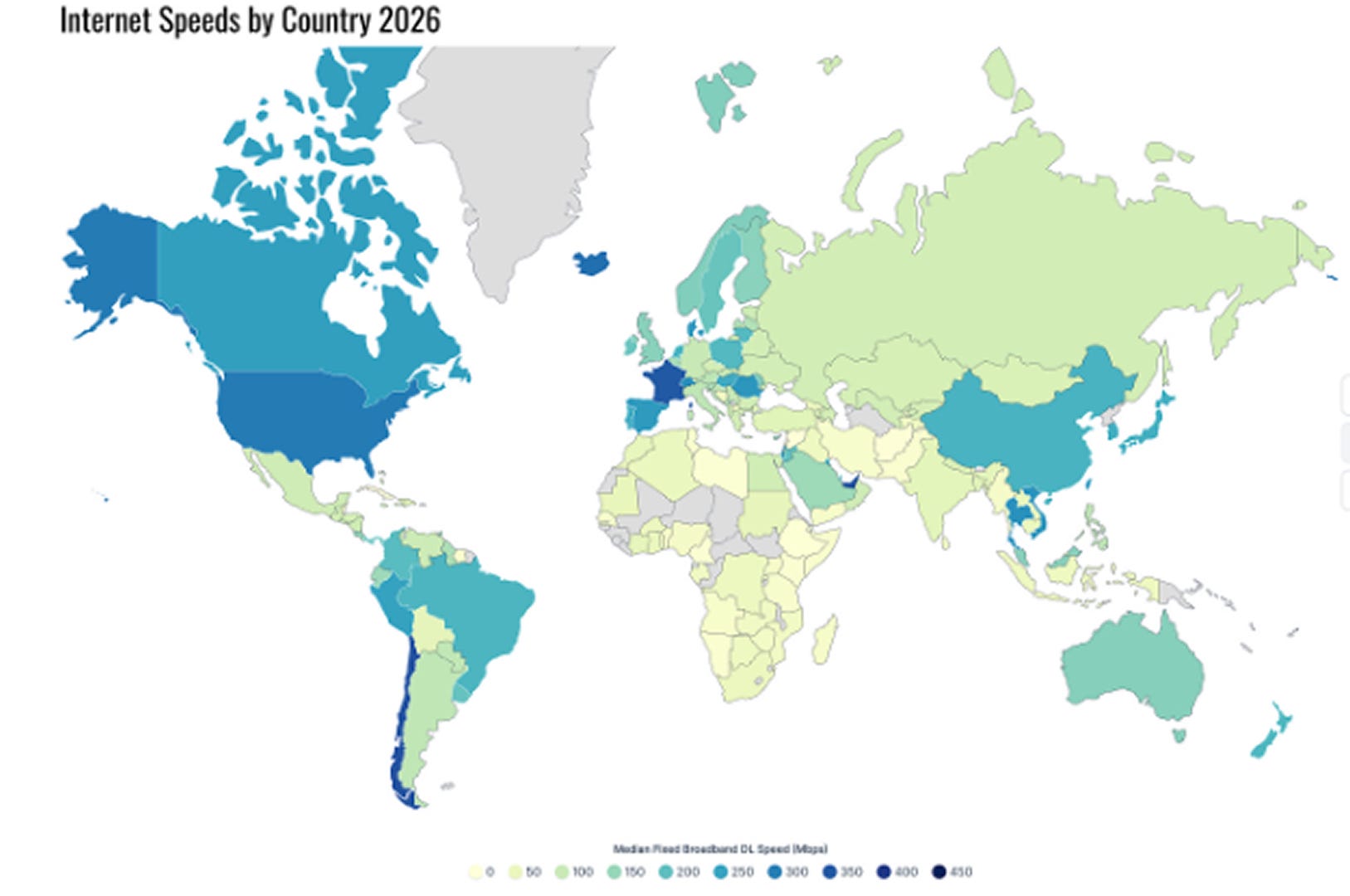
Here are internet speeds by country in 2026, with Australia coloured a lovely shade of mid-green only slightly darker than parts of Africa, Russia and South America. Our connection speed is 164 Mbps on average - that’s 2.5 times slower than Singapore where inhabitants enjoy 407 Mbps. In the rankings we’re sitting at number 43 below Vietnam, Romania and Peru. The average Australian pays $85 a month for this, while South Koreans are watching 8K video on connections faster than most Australian businesses can access.
Meanwhile Elon Musk and SpaceX have built a global satellite broadband network that runs with an average latency of 31 milliseconds. The NBN’s satellite service runs at 663 milliseconds. In 2025 Musk suggested Albanese’s most recent injection of equity into the project would be better spent elsewhere.
4:50 AM · Mar 14, 2025 · 19.1M Views
11.8K Replies · 15K Reposts · 88.1K Likes
So yes, it is hard to argue that this boondoggle from 2009 has not been a catastrophic failure from beginning to end. It’s a classic “We spent $6,000 per household over seventeen years and all we got was this lousy connection and the inspiration for 5 seasons of Utopia” moment.
The government decided within hours that it knew best and proposed its own government-owned monopoly solution
What would the market have delivered by 2026 if the government hadn’t cleared the field and handed NBN Co a monopoly? Nobody can say, but South Korea made different choices about market structure and competition and has 1Gbps fibre for the price of a modest dinner out.
The take-away is this: when a government entity builds infrastructure, there is no price signal telling it to stop spending. There are no shareholders demanding answers, and no meaningful consequences for cost overruns other than some uncomfortable moments in a Senate estimates hearing. In the case of the NBN, competition was made structurally impossible via the NBN level playing field provisions enacted in 2011, further removing access to vital information on the project’s viability.
Every government project suffers from Hayek’s knowledge problem: the NBN architects knew what they wanted to build, but what they didn’t know was whether it was worth building, at what cost, using what technology and on what timeline.

I remember when I lived in the US, a basic cable TV and internet plan cost about US$20/mo which gave you 100Mbps... in 2010. This now costs about $50USD in Australia. I'm on Gigabit NBN, the fastest home connection. When I tried to upgrade, and because NBN is treated like some scarce public utility, my old ISP told me I "didn't need it" because I live alone and the "hyperfast" (LOL) speed is only suitable for "large households." Irrelevant. I want it, I have the money to pay for it, give it to me. Nope. And we all pay the price.
As Thomas Sowell said, “It is difficult to imagine a more dangerous way of making decisions than by putting those decisions into the hands of people who pay no price for being wrong.”