


Libertarianism is all about the freedom of individuals from coercion, based on JS Mill’s harm principle: ‘The only purpose for which power can be rightfully exercised over any member of a civilised community, against his will, is to prevent harm to others.’
Within a country there is no confusion – reductions in tax and increases in liberty are supported, increases in tax and reductions in liberty are opposed.
But when it involves matters outside the country, libertarians often make it complicated. How is libertarianism affected by national borders? Can it apply to relationships between sovereign states? To what extent should libertarians oppose coercion in other countries?
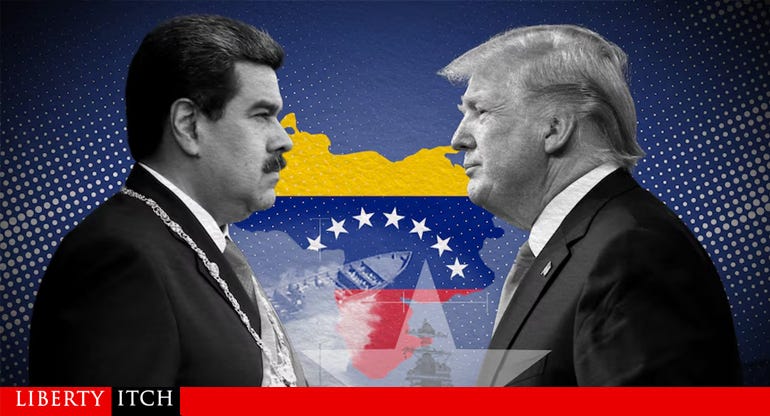
Trump’s intervention in Venezuela has not only prompted many on the left to denounce him, but quite a few libertarians as well. The left’s position is easy to understand – a socialist was removed from power, by their arch enemy Trump.
The libertarian opposition comes from a completely different position. I believe it is similarly incorrect but, since I also describe myself as libertarian, I feel obliged to explain my reasoning.
American politics has been significantly influenced by the inaugural address of US President Thomas Jefferson in 1801, who declared that the US should consider its external military alliances to be temporary arrangements of convenience to be abandoned or reversed according to the national interest. Citing the Farewell Address of George Washington as his inspiration, Jefferson described the doctrine as “peace, commerce, and honest friendship with all nations - entangling alliances with none.”
Values are what distinguish libertarians from others, and they should not be jettisoned because of a collectivist concept.
Known as the Washington Doctrine of Unstable Alliances, this thinking dominated US foreign policy right up to the Second World War. And although America now has long term alliances with many countries, including Australia, the doctrine remains influential in American political circles.
That is especially true of American libertarians and, consequently, some libertarian Australians. In their view, a country should take little interest in squabbles beyond the country’s borders unless there is a clear threat to its ability to engage in trade and commerce. They only endorse the use of force to end coercion if it occurs within their own country’s boundaries; not when it occurs outside them. They are even reluctant to criticise or condemn outside coercion, and reject non-violent options such as sanctions.
This assigns great significance to national boundaries, a concept that assigns people to groups based on location. However, boundaries are collectivist and have no inherent virtue; indeed many, including America’s, are an outcome of expediency, wars, and political deals. They do not deserve such significance.
It also takes no account of values. While blood and treasure must always be expended cautiously, assigning priority to geographic boundaries has potentially quite peculiar outcomes.
If there was substantial coercion occurring within Australia, Australian libertarians would agree it must be resisted. Moreover, if it was occurring in Tasmania, nobody would claim that taxpayers in New South Wales should not contribute to that resistance.
If the same coercion was occurring in Papua New Guinea or New Zealand, on the other hand, plenty would argue that it was not Australia’s concern. They would claim it is not moral to spend either the blood or treasure of Australians to stop it.
This is morally indefensible. Values are what distinguish libertarians from others, and they should not be jettisoned because of a collectivist concept.
By any libertarian standard, the removal of Maduro as President of Venezuela is to be applauded. He was a corrupt socialist dictator.
Whether it was a wise use of American taxpayers’ money is yet to be seen; much depends on what comes next. Some prior examples of intervention have been sound in principle but not in execution; Vietnam, Iraq, Afghanistan, Nicaragua and Guatemala for example.
They only endorse the use of force to end coercion if it occurs within their own country’s boundaries; not when it occurs outside them.
On the other hand, Panama turned out well, and America and Australia’s intervention in Korea saved the people in the south from suffering the same miserable fate as those in the north. And Australia’s intervention in East Timor ensured the country would not suffer heavy-handed military rule by Indonesia, now apparent in West Papua.
None of this shows that intervention to overcome coercion is inherently wrong because it crosses a national border, or that it is inevitably a good idea. Rather, it shows that circumstances differ and judgement, caution and planning are vital.
What it means is, there is no libertarian justification for doing nothing about coercion merely because it is occurring in another country. Coercion should always be our concern, wherever it occurs.
It does not mean rushing military aid to those subject to coercion in other countries. There are many reasons why that might not be possible, practical, or advisable. Sometimes it might make sense; sometimes not. But it is perfectly legitimate for libertarians to consider whether there is anything they can do to overcome coercion wherever it occurs.
JS Mill was an advocate of utilitarianism in addition to classical liberalism. This philosophy, generally attributed to Jeremy Bentham, is often summarised as the pursuit of the greatest good for the greatest number. For libertarians, it should be understood to mean the greatest liberty for the greatest number. Mill would agree.

Sorry David, as much as I consider myself somewhat libertarian I also have a strong sense of nationalistic pride & patriotism that come with geographic boundaries. Despite our governments' (note plural) dismal economic performance the most contentions issues in Australia today, which clearly divide the nation are events occurring in other countries which neither impact Australia nor are we in a position to remedy. We are about to be inflicted with draconian speech laws which are little more than political censorship because of a battle between Zionists & Muslims. Hatred of either side achieves nothing more than to destroy any chance of social cohesion in this country .
Thank you David. Just some thoughts.
If a number of libertarians wish to form a group without harming others, such as a business firm, or even a country, then who has a right to prevent them? National boundaries can arise legitimately from Libertarians forming groups. I don’t believe National Libertarians would see national boundaries as an artificial collectivist notion. The location of national boundaries becomes under question when boundaries between nations are changed. On one hand, we can ask who had a right to prevent people in NW Czechoslovakia from joining their patch of land to Germany in 1939, or to prevent people is SE Ukraine from joining their patch of land to Russia in 2022. But it is a different thing to ask who has a right to ASSIST people in those patches to be free to secede or join another nation.
Suppose a powerful Libertarian nation gave un-requested assistance to Venezuelans, Iranians (Persians), North Koreans, and others, to join an international commonwealth of Libertarian nations. Very tempting of course! But would a people who were assisted in this way be stronger in the longer term if they chose the offered Libertarianism rather than chose what they could create on their own? Would they need continued ‘assistance'? And would a globalised mass of uniform Libertarians give a more robust world system than competing localised variations of individual nations?
Requested assistance could perhaps look like this: a powerful group within a nation (probably including the regular army), that could retain power on its own, requests assistance for the purpose of hastening the inevitable and reducing destruction.
It’s a terrible lesson to see what sort of a non-libertarian world we have been living in, thinking of Persia in particular as we sit today.
And we can draw the lesson that if we give ANY government a monopoly over guns and violence, then they WILL take control of information, and then what do we get? Thinking of us: Australia, Britain, Canada ...