


We are constantly told that Australia has a huge road toll. Every holiday and long weekend there are reports of how many people were killed amid inferences that this is a major and growing tragedy.
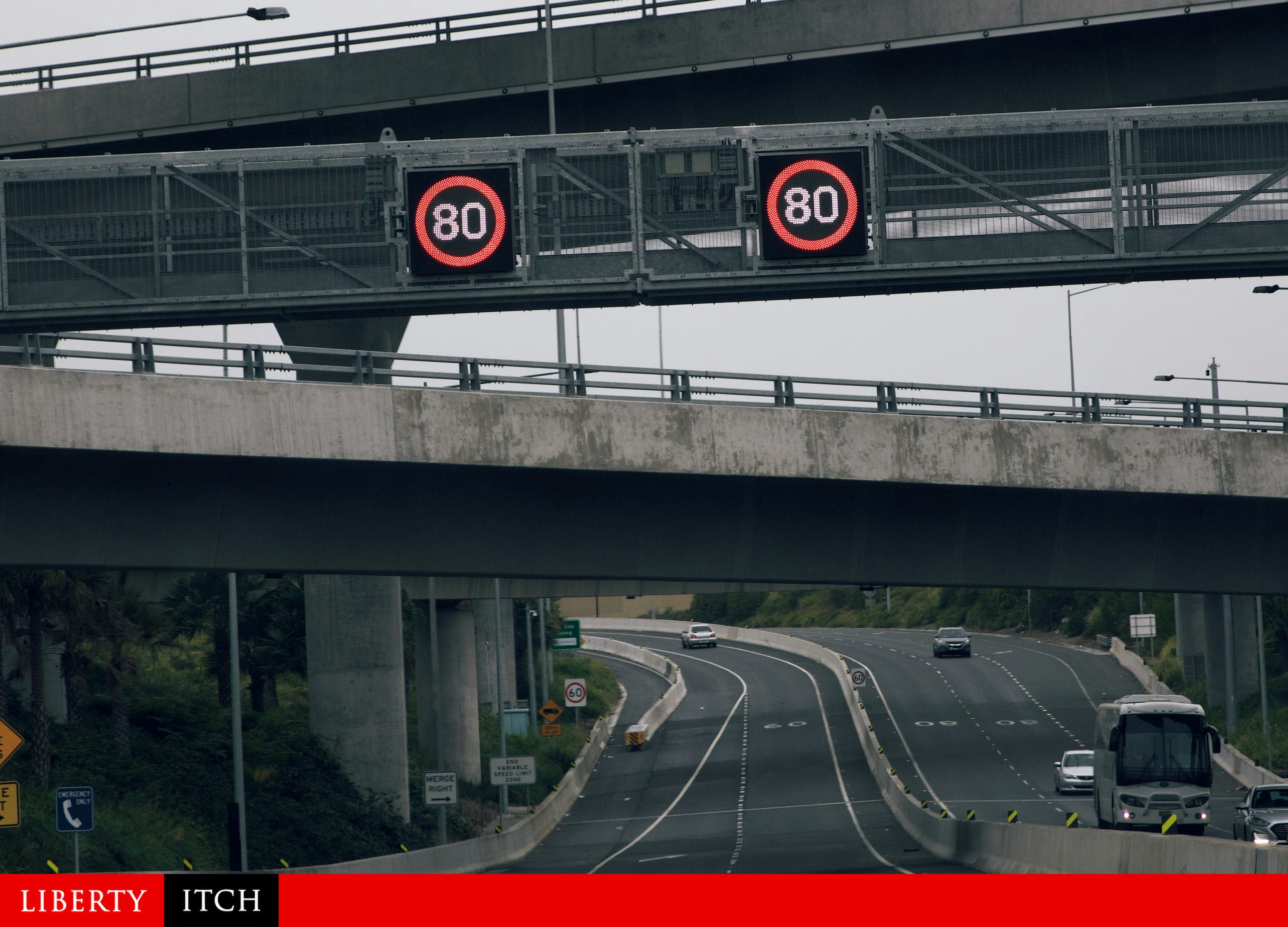
Equally constant is the assertion that the underlying cause is speeding. There is a never-ending campaign, complete with gory advertisements, telling us to slow down.
The message never varies – below the speed limit is safe, above the limit is not. Indeed, we are told that even 1km/hr above the speed limit increases the likelihood of serious injury and death. Bubble-headed journalists blame speed for almost every accident they cover.
And should we fail to heed the message there are speed cameras, aerial monitoring, highway patrols and double demerit periods to remind us.
Australia’s road toll is not abnormally high. Fewer people die in road accidents than from influenza.
In reality, driving on Australian roads is safer than it has been for over fifty years. Road fatalities, both absolute and relative to the population, have been steadily falling. Whereas in 1970 there were 3,798 road fatalities, equal to 30.4 fatalities per 100,000 people, in 2025, there were 1,314 road fatalities, approximately 4.7 to 4.8 per 100,000.
Most of the decline occurred prior to 2000 following the introduction of seat belts, improved road design, vehicle safety upgrades such as disc brakes and impact resistance, and limits on drink-driving.
Some countries achieve rates nearly half of Australia’s, including Norway (2.0), Iceland (2.1), Sweden (2.2), the United Kingdom (~2.5), and Japan (~2.6). However, Australia has a lower rate than similar car-dependent countries such as Canada (~5.0) and the United States (~12.4).
Geography is important; Australians travel high distances per capita. While major urban jurisdictions like the ACT (1.9) and NSW/Victoria (4.1) perform close to or better than the OECD median, vast distances and long emergency response times in regional and remote areas push Australia’s national average higher.
The point is that Australia’s road toll is not abnormally high. Fewer people die in road accidents than from influenza. And yet, rather than celebrate this success, governments perpetuate the fiction that things are bad and getting worse.
Moreover, despite quite minor changes to speed limits over the period (slight increase on highways and slight reduction in the suburbs), it insists that excessive speed is the primary culprit.
This while most of Europe, with lower road death rates, has overall higher speed limits than Australia. That includes Germany, where there are no speed limits on major autobahns.
Responsibility for the speed myth lies with the National Road Safety Strategy, prepared every few years by transport and infrastructure bureaucrats from the Commonwealth, State and Territory governments. For many years it has led a crusade with the broad aim of significantly reducing road trauma, resulting ultimately in zero deaths and serious injuries (defined as anyone admitted to hospital, irrespective of seriousness or the length of stay) by 2050.
It argues speed is a key element in all crashes, and that this necessitates lower speed limits and additional enforcement. State and Territory governments, which collect over $1.5bn in speeding fines, applaud enthusiastically.
While very high speeds can obviously lead to more serious accidents, the data shows that deaths occur at all speeds. Indeed, achieving zero deaths and injuries from road accidents would only be achievable if everyone walks (even then, some will die of heart attacks). That would clearly be unacceptable to the community, which implicitly accepts a certain level of deaths and injuries as the price of convenient travel.
The elevation of speed limits to icon status is both dishonest and morally wrong. Those responsible for setting limits, road safety experts and traffic engineers in the public service, are deciding the trade-off between convenient travel times and the road toll for the entire community. If speed is truly the demon we are led to believe, they are essentially determining how many people should die.
If this all sounds eerily similar to events during the Covid epidemic, that is not surprising. The gross overstating of a public health risk; a determination to mitigate that risk without regard for economic or social consequences; an assumption that the public are not competent to make their own decisions about bearing that risk. It’s all the same.
Nobody wants to increase deaths and injuries on the roads, but a risk-free society is not a rational public health objective.
As with Covid, it is gross bureaucratic overreach. It is the public, not bureaucrats, who should determine the trade-off between travel convenience and the road toll.
There is an internationally recognised method of achieving this, known as the 85th percentile formula. Briefly, it involves the temporary removal of speed limits while speeds are monitored. At the conclusion of the period a limit is reimposed at or slightly above the speed at which 85 per cent of drivers travel.
The method is based on the assumption that most drivers are reasonable and prudent, do not want to crash, and wish to reach their destination in the shortest possible time. Evidence shows that those who drive substantially above or below speed limits based on the 85th percentile are far more likely to cause accidents. Enforcement directed at those drivers thus has a positive impact on road safety, while enjoying a high level of driver support. Should the public become concerned about the level of road deaths or injuries, this can be expressed by redetermining the 85th percentile.
If the government serves the people rather than vice versa, speed limits should have the approval of most drivers. Instead of being treated like sinful children and a source of revenue, motorists should be the ones who decide what the limits are.
Nobody wants to increase deaths and injuries on the roads, but a risk-free society is not a rational public health objective. Road users are not sinful children and should not be viewed as a source of government revenue, and public health bureaucrats should not be allowed to play God.

Agree 100%! It’s all about revenue raising and control. One Council, Moreland City Council in Melbourne (I refuse to call them by their new name!) is ‘trialling’ 30km speed zones to help reduce the death toll. I’m not sure if there are any statistics to back their claims but you can bet your bottom dollar this ‘trial’ will become permanent. BTW, for those who don’t know, this Council is one of worst woke councils in Victoria! 🤬