


When Australia was first settled, a key priority was to clear the land for crops and livestock. The first five years of the penal colony (1788-1792) are often referred to as “the hungry years” due to severe food insecurity.
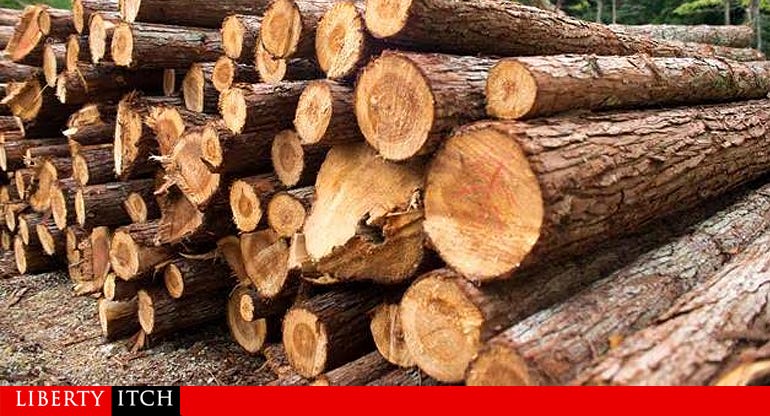
The cleared trees (nearly all hardwood eucalypts) were used to build houses, fences and public buildings, to make furniture, and to construct infrastructure such as bridges and railways.
Almost no timber was imported from England. Australia was blessed with vast forests and billions of trees, leading to the establishment of a thriving forestry industry.
However, it was also recognized that this resource was not limitless. In 1871, the first forest reserves were proclaimed in NSW to preserve the timber resource of the colony. By 1905, more than three million hectares of land were in timber reserves.
In 2012, research showed that 50% of Australia’s forests remained intact compared with pre-colonisation. The rest had been cleared for agriculture or other human needs, including housing. That leaves around 134 million hectares of forest covering about 17% of the land area, mostly native forest (132 million hectares), while commercial plantations comprise around 1.7 to 1.8 million hectares (of which the majority are softwood).
Forests are a renewable resource; harvested trees can be (and are) replaced. In principle there is no reason Australia should ever need to import timber. But investing in plantations is a very long-term investment, particularly with slow growing hardwoods. A high level of certainty as to its future value is needed.
For decades, the forestry industry has been subject to inexorably increasing restrictions. It has now reached the level of effective bans on hardwood logging, with wide-ranging economic, ecological, and institutional consequences. One of the most visible outcomes is that Australian houses, public buildings, and furniture are increasingly being constructed from trees grown, harvested, and processed in other countries.
Timber processing facilities often function as anchor employers, sustaining local supply chains, apprenticeships, and population stability
Since 1990, timber production from state forests has been governed by Regional Forest Agreements (RFAs), which were intended to provide long-term certainty by balancing conservation and production objectives. In practice, successive amendments have progressively reduced available logging areas, each time accompanied by assurances that the settlement was final.
Even before RFAs, states had already been reducing the proportion of forest land available for harvesting. The share of forests open to logging fell from around 27 per cent in 1990 to under 10 per cent today, with remaining areas heavily conditioned by procedural and operational constraints. Victoria and Western Australia have now formally closed all state forests to logging, effectively ending native hardwood production in those jurisdictions.
The Albanese Government’s recent revisions to the Environment Protection and Biodiversity Conservation framework further destabilises what remains of the sector. By ostensibly requiring environmental review of each individual logging coupe, the legislation introduces a transaction burden that is practically unworkable at scale. The legal uncertainty alone has chilled investment, accelerated industry exit, and discouraged workforce renewal. The result is the de facto termination of domestic hardwood supply from public forests.
While this may be motivated by sincerely held concerns about biodiversity loss, climate change, and environmental integrity, it has produced effects that extend well beyond forest conservation. The cumulative result has been to restructure domestic timber supply, intensify import dependence, weaken regional industries, complicate land management, and expose tensions between environmental ambition and practical stewardship.
The legislation marks a decisive expansion of federal authority in environmental regulation, with the EPA gaining powers to issue 14-day stop-work orders and levy fines of up to $1.5 million.
In parallel, Environment Information Australia will compile biennial “State of the Environment” reports and designate “national environmental information assets”, consolidating the Commonwealth’s role in defining environmental baselines and priorities. These reforms extend federal oversight into matters of national environmental significance, including threatened species, World Heritage sites, wetlands, and emissions-intensive projects, embedding an additional approval layer into land and resource use decisions.
The result is a sharp increase in timber imports. Removing local supply for furniture, flooring, cladding, joinery, and structural applications does not eliminate demand; it displaces it offshore. Between 2015 and 2024, total forest and wood product imports increased by approximately 53 per cent in real terms.
By 2024, around 90 per cent of Australia’s hardwood consumption was met through imports, sourced primarily from Southeast Asia, Europe, and South America. Imported hardwood is used extensively in residential construction, engineered wood products, furniture manufacturing, and interior finishes – sectors that historically relied on locally harvested native timber.
Timber imports now represent several billion dollars annually in foregone domestic production. Regulatory oversight in exporting countries varies widely; in some jurisdictions there is illegal logging, weak labour protections, and poor environmental enforcement. While domestic logging bans may reduce visible impacts within Australia, they externalise environmental and social costs elsewhere, undermining the global conservation objectives they are intended to advance.
Australia was blessed with vast forests and billions of trees, leading to the establishment of a thriving forestry industry
The contraction of the hardwood sector also carries significant regional consequences. The native timber industry has traditionally supported tens of thousands of direct and indirect jobs across harvesting, haulage, milling, manufacturing, silviculture, and associated services. Many of these jobs are located in regional and rural communities with limited alternative employment opportunities.
Timber processing facilities often function as anchor employers, sustaining local supply chains, apprenticeships, and population stability. The closure of state forests to logging has therefore imposed adjustment costs that are unevenly distributed, with regional communities bearing the brunt of policy decisions largely driven from metropolitan centres.
The ecological consequences of logging bans are likewise more complex than often assumed. The prevailing narrative anticipates the restoration of pristine wilderness through exclusion of extractive activity. However, the removal of active forest management has, in many regions, contributed to dense understorey growth, weed proliferation, and increased habitat for feral species such as cats. These conditions elevate fuel loads and disrupt ecological balance. The 2019–20 Black Summer fires starkly illustrated these dynamics, with vast tracts of unmanaged forest acting as tinderboxes under extreme weather conditions. The absence of selective harvesting, road maintenance, and fuel reduction materially shaped the severity and spread of those fires.
Australia’s restrictions and bans on hardwood logging exemplify the unintended consequences of environmental policy when regulatory ambition outpaces institutional capacity and ecological nuance. The substitution of domestic production with imports, the erosion of regional industries, the deterioration of active land management, and the layering of approval regimes raise fundamental questions about effectiveness, proportionality, and coherence.
Conservation outcomes depend not only on exclusion but on stewardship; economic sustainability requires alignment between domestic demand and supply; and environmental credibility hinges on accounting for global, not merely national, impacts.
