


For a long while now, Australians have sensed something was fundamentally off. Our wages don’t keep up. The house drifts further out of reach. Electricity, food, insurance and rent all rise much faster than our pay packets. Every year feels that much harder than the last.
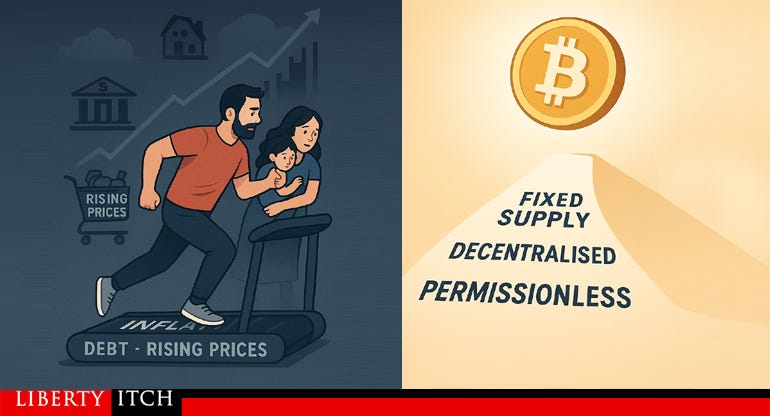
Folks blame “corporate greed”, “global events”, or “supply chain issues”, but seem unaware that the real driver is far simpler, and far more sinister:
Australia expanded its broad money supply (M3) by roughly 80% between 2015 and 2025.
That means there is nearly double the money in circulation, but the number of houses, goods and productive hours has barely moved. When you double the dollars but not the economic output, the result is very predictable:
“Everything becomes more expensive”
Inflation isn’t just about rising prices at the shops. It’s a currency redistribution mechanism. When new money is created, it enters the economy through our governments, banks, and asset markets. They get the purchasing power first; everyone else gets what’s left over.
Simply put, the winners are:
All Governments (more spending without needing to raise taxes)
Banks (more lending, bigger balance sheets, more profit)
Asset holders (property, shares, land owners)
The losers are:
Wage earners
Savers
Renters
Small business owners
Anyone not holding these nominally inflating assets
Bitcoin is not a silver bullet, but it is a life-raft that finally puts regular Australians like us on equal footing with the institutions
This is why the middle class is being hollowed out. Not because they work less; they’re actually working much harder. But because what they are paid for this work is diluted more rapidly than they can earn it.
Monetary debasement forces Australians into an exhausting behavioural loop:
Work more hours to cover stagnant wages
Take on more debt to chase rising house prices
Speculate on investments because saving loses purchasing power
Pay higher taxes as the bracket creep pushes incomes upward
Absorb higher costs for energy, food, insurance and essentials
Rely more on government because the system erodes our independence
This treadmill is not accidental, but the engineered outcome of a system in which the authorities can expand money supply without restraint, and the cost is imposed on those with no voice in monetary policy.
State debt is slated to be over $44b in South Australia by 2027.
Australia relies on a single political currency controlled by a single political institution. That means:
Supply is manipulated
Price of money is set by decree
Savers have no choice
Citizens bear the inflation cost
Governments face no immediate discipline
In any other industry, we would recognise this as a clear monopoly with unavoidable abuses of power.
There are options.
Bitcoin’s importance is often misunderstood by economists and politicians. It is not primarily an investment, and it is not a tech fad. It is best understood as a monetary alternative. It was designed as a voluntary exit from a system that punishes savers and rewards debt.
Bitcoin’s features directly counter the weaknesses of our current system:
Fixed supply — no politician can dilute it
Decentralised — no central bank can weaponise it
Borderless — individuals can protect wealth anywhere
Permissionless — anyone can save or transact
Predictable issuance — monetary schedule set in code, not meetings.
YOU CAN’T MAKE MORE OF IT.
Bitcoin doesn’t seek to replace the Australian dollar; it simply offers Australians a viable second option. A pressure release valve. Bitcoin is a parallel system that restores the link between effort and savings.
Not unlike the famous Friedrich Hayek quote along the same lines,
“I don’t believe we shall ever have good money again before we take the thing out of the hands of government…
…that is, we can’t take it violently out of the hands of government; all we can do is by some sly roundabout way introduce something that they can’t stop”
In a world where governments routinely debase money, Bitcoin is the closest thing to monetary honesty we’ve had since the gold standard.
That means there is nearly double the money in circulation, but the number of houses, goods and productive hours has barely moved.
Australia does not need radical upheaval; it just needs more free choice. That alone disciplines our governments and empowers our citizens.
A few simple changes could dramatically help ordinary Australians:
Introduce a Bitcoin de minimis threshold so small transactions are tax-free.
Enable states like South Australia to experiment with Bitcoin-backed bonds.
Allow citizens to save in a currency the government cannot dilute.
Encourage hard saving over forced speculation.
Align incentives so productivity, not printing, creates prosperity.
These are not fringe ideas anymore. U.S. states are already doing this. Japan and Singapore are regulating Bitcoin sensibly. Countries like Switzerland are integrating it into their local municipal finance.
The middle class isn’t collapsing in Australia because of laziness, global conspiracies, or the corporate villains. It’s collapsing because the money we earn loses value faster than we can live our lives.
This is not sustainable.
Bitcoin is not a silver bullet, but it is a life-raft that finally puts regular Australians like us on equal footing with the institutions that quietly siphon away our purchasing power.
For a nation like Australia built on fairness, hard work and self-reliance, giving people the right to opt into a sounder monetary alternative may be the most pro-Australian reform imaginable.

I never grasp how government does not understand the most basic principle of, when you allow the citizenry to thrive, the country prospers. Despite the various angles I look to understand how the bureaucracies don’t or won’t acknowledge this, I come back to the same conclusion - they are so ensconced in a bubble that they truly believe they know best, and they can do this because they are detached from real people living real lives.
I’m still grappling with understanding bitcoin, but your article explains it in the best way I’ve read yet, Tyler.
Well explained Tyler . Definitely food for thought .