


Man is born free yet everywhere he is in chains.
Following last month’s article in which I discussed Rousseau’s quest to determine whether a government can be considered legitimate in a political society, I now explore a term which is rather like an oxymoron – forced to be free.
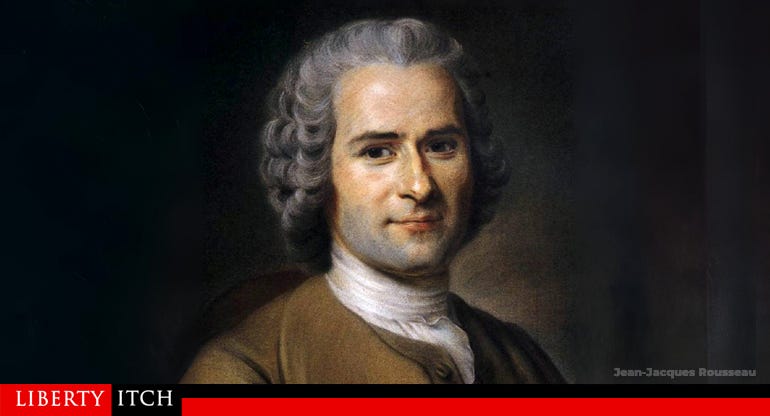
Why would anyone need to be forced to become free in a modern democratic society?
The answer lies within the bounds of the general will – that all-encroaching term that defends the idea of the greater good. Rousseau describes it as an institution that binds all people together as one, and through this general will, a sense of harmony and justice results in equity and fairness because it is aimed squarely at the greater good:
So long as several men assembled together consider themselves a single body, they have only one will, which is directed towards their common preservation and general well-being.
Whoever deviates from the expectations of the general consensus could find themselves in a spot of bother. Those who have a private will may consider a duty to the collective as an imposition on their individual rights, and hence be considered as not model citizens, something Rousseau argues could bring about the ruin of the body politic:
Whoever refuses to obey the general will shall be constrained to do so by the whole body, which means nothing other than that he shall be forced to be free.
Rousseau explores the social contract as the answer to the fundamental problem of how to bring together the mass of people who agree on most things, if not everything, and those who do not – the free thinkers.
Australians are about to march against heavy handed and attitudinal indifference toward citizens by their government.
His definition of the solution is worthy of full quotation due to how chilling and apt it is for our times. This paragraph alone conjures up World Economic Forum vibes. In fact, I argue the WEF must have used Rousseau as its muse:
“These articles of association, rightly understood, are reducible to a single one, namely the total alienation by each associate of himself and all his rights to the whole community. Thus, in the first place, as every individual gives himself absolutely, the conditions are the same for all, and precisely because they are the same for all, it is in no one’s interest to make the conditions onerous for others.
Secondly, since the alienation is unconditional, the union is as perfect as it can be, and no individual associate has any longer any rights to claim; for if rights were left to individuals, in the absence of any higher authority to judge between them and the public, each individual, being his own judge in some causes, would soon demand to be his own judge in all; and in this way the state of nature would be kept in being, and the association inevitably become either tyrannical or void.”
Granted, he is outlining solutions for people to live together in some degree of harmony; to engineer a state of being in which all citizens can cooperate while maintaining some degree of liberty. It is the age-old problem of political societies, one that has plagued all of them from ancient Sparta to Greece, Republican Rome, and to the enlightenment thinkers like Hobbes, Locke, and Paine.
You would think that by now, in 2025, we could get the formula right. Alas, those problems remain because humans essentially remain the same.
In our postmodern era it is clear that most people have no issue abandoning their personal liberties, as 2020 clearly revealed with the pandemic madness of handing over our health decisions to politicians and bureaucrats. Now, co-opting with the government is about to reach new heights; first home buyers will soon be able to enter into joint ownership with the government via a 5% deposit that will guarantee a portion of their home loan. It will no doubt be attractive to many young buyers who are attempting to purchase property in a market that is out of reach for most.
For libertarians, the problems arise with the refusal to obey the general will if it goes against or hinders what they believe to be best for themselves and their families. This was most evident during Covid mandates and lockdowns and is likely to remain the case when Australia’s draconian censorship of the internet and social media roll out in December this year. Their pushback is not about refusing to fall in line with the collective, but rejecting creeping totalitarianism. Not only is it an affront to a core tenet of liberty, but it has no place in a modern democratic society.
The vast majority of people simply want to be left alone to provide for their families, enjoy leisure time, and be able to make decisions they consider best for themselves without doing harm to others, a concept which is being thwarted at every turn by government overreach.
Why would anyone need to be forced to become free in a modern democratic society?
Rousseau argues that humans really never disassociate themselves from the social contract because it provides them with far more security and harmony than what they could find by being outside the pact: although people will surrender some of their advantages of belonging to the state of nature, they gain more – enlargement of one’s mind; sentiments that become ennobled; and an elevated spirit.
For most people it would be a challenge to extricate themselves from the mainstream completely, but so long as governments become more authoritarian there will be an increase in those who seek a life outside of cities in rural or semi-rural settings, with some even choosing to live off-grid.
As the government continues to intrude further into our lives, is it any wonder that some seek a lifestyle as far away from its clutches as possible?
This is hardly a surprising question, and one which Rousseau acknowledges, that should the state become ruinous through unreasonable edicts and corruption, it will surely fall. The illusion and emptiness that ensues from a government gone rogue will result in a broken social contract, a state which he describes as “impudently flaunting the sacred name of the public good via the meanest interest.”
Irrespective of whether you regard the public good as “sacred”, there are few who would disagree that it must be in a far less intrusive form than we currently have.
As I write, Australians are about to march against heavy handed and attitudinal indifference toward citizens by their government. To that can be added, against the illusion and emptiness of a state that has lost its grip on the very reason for its existence – a duty to uphold liberty for all.
